
Stress maps
Linear Static Analysis
Stress, displacement, stiffness, and safety-factor studies for validated load cases.
supported stack
ANSYS / Abaqus
Advanced simulation-driven engineering workflows for structural integrity, durability, thermal systems, crashworthiness, NVH, and digital validation.
PANSOFT delivers integrated CAE and simulation consulting solutions spanning structural mechanics, CFD, thermal systems, optimization, multiphysics analysis, and AI-assisted engineering intelligence.
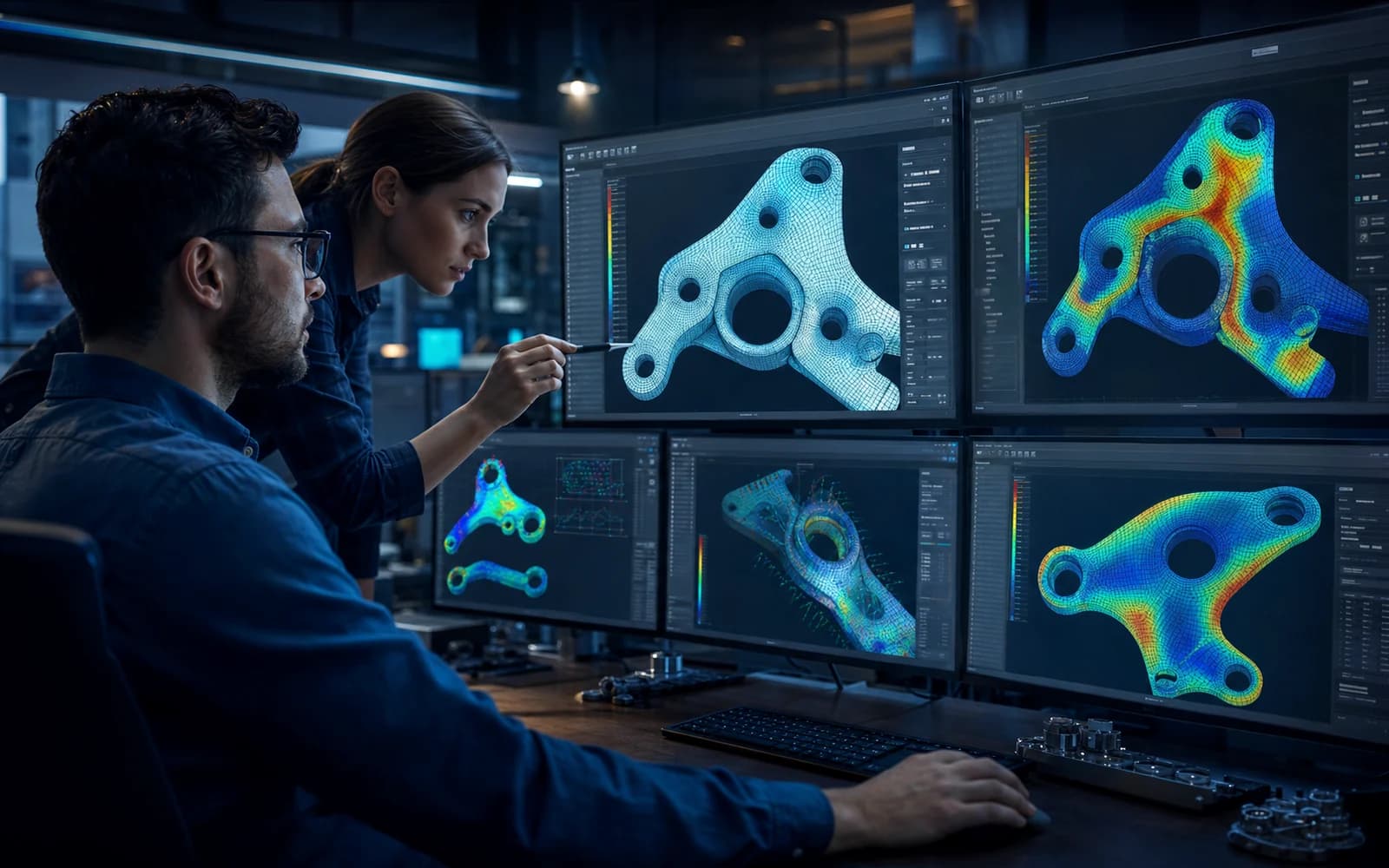
Stress, displacement, stiffness, and safety-factor studies for validated load cases.
Material, contact, geometric, and large-deformation behavior for realistic product response.
Life prediction, duty-cycle assessment, hot-spot screening, and durability improvement.
Impact, crashworthiness, drop, crush, and high-rate transient event simulation.
Conduction, convection, thermal stress, heat paths, and temperature-driven reliability.
Internal/external flow, cooling, pressure drop, fan systems, aerodynamics, and HVAC.
Coupled structural, thermal, flow, vibration, and field-driven engineering behavior.
Dynamic response, resonance, acoustic behavior, FRF studies, and product refinement.
Natural frequencies, mode shapes, stiffness paths, and resonance separation.
Frequency-domain response prediction, excitation behavior, and resonance mitigation.
Weight reduction, stiffness improvement, load-path discovery, and manufacturable design direction.
Composite layups, laminate performance, failure criteria, and lightweight structural validation.
Hex/tet/shell/solid mesh strategies, quality checks, contacts, and solver-ready idealization.
Load cases, contacts, constraints, scripts, templates, and repeatable solver workflows.
Test-to-simulation comparison, KPI confidence, model tuning, and validation reports.
Simulation results connected with dashboards, field data, performance KPIs, and analytics.
Crash, durability, battery thermal CFD, e-drive cooling, NVH, lightweighting, and validation readiness.
Automated diagnostics, solver pattern recognition, reporting systems, and KPI dashboards help teams make faster validation decisions.
Reduced thermal hotspots
Improved cooling performance across pack operating cases
Maintained safety with lightweighting
Improved structural load paths and impact response
Reduced thermal fatigue risk
Improved thermal gradients and material confidence
Durability life improvement
Critical hot spots identified and redesigned
Airflow optimization
Improved power efficiency and rack thermal balance