
Cd / Cl
External Aerodynamics
Vehicle, aircraft, equipment, and exposed-product airflow studies for drag, lift, cooling intake, and wake control.
solver ecosystem
Fluent / STAR-CCM+
Advanced fluid dynamics, thermal management, aerodynamics, and multiphysics simulation for modern engineering systems.
PANSOFT delivers integrated CFD-driven engineering workflows spanning aerodynamics, thermal systems, multiphase flow, electronics cooling, HVAC optimization, and digital validation for high-performance product development.
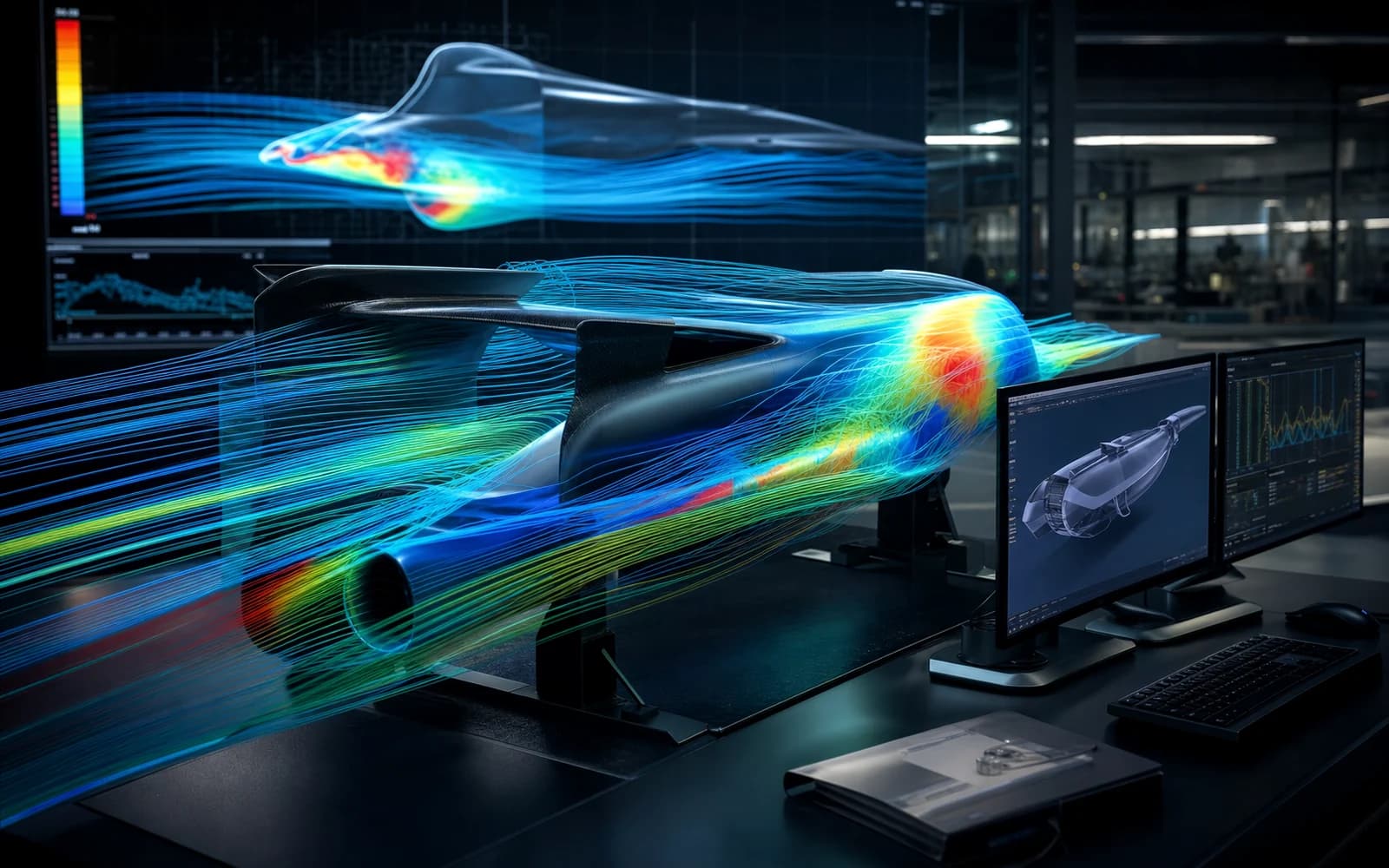
Vehicle, aircraft, equipment, and exposed-product airflow studies for drag, lift, cooling intake, and wake control.
Ducts, manifolds, pumps, valves, plenums, and internal passages evaluated for losses and flow balance.
System-level heat rejection, temperature limits, heat paths, and thermal operating envelopes.
PCB, enclosure, fan, heat sink, and component cooling studies for reliable electronics operation.
Cell, module, and pack cooling with liquid channels, cold plates, abuse risk, and thermal uniformity.
Cabin airflow, vents, thermal comfort, defog, ducting, and HVAC air-distribution optimization.
Free surface, sprays, bubbles, sloshing, cavitation, particulate flow, and phase interaction studies.
Loss coefficients, restriction studies, fan and pump sizing, filter loading, and flow network decisions.
Fluid-solid thermal coupling for heat exchangers, cold plates, housings, and electronics systems.
Fans, pumps, compressors, turbines, MRF/sliding mesh, performance maps, and stall risk evaluation.
Reacting flow, flame behavior, emissions sensitivity, mixing, and thermal load prediction.
Liquid circuits, coolant loops, hydraulic paths, drainage, pressure balance, and flow stability.
Rack airflow, containment, thermal recirculation, fan strategy, and energy-efficiency improvement.
Flow-induced noise, fan acoustics, tonal sources, wake interaction, and comfort-related sound paths.
Parametric studies, DOE, geometry improvement, reduced-order insight, and performance trade-off decisions.
CFD evidence connected to sensor data, telemetry, test correlation, and operating dashboards.
Battery cooling, underhood thermal, aerodynamics, e-drive cooling, cabin HVAC, brake cooling, and thermal validation.
stage 1
Geometry Preparation
stage 2
Fluid Domain Extraction
stage 3
Meshing Strategy
stage 4
Boundary Conditions
stage 5
Physics Models
stage 6
Solver Execution
stage 7
Post Processing
stage 8
Validation & Optimization
AI-assisted diagnostics compress CFD review cycles by surfacing mesh quality risks, unstable convergence patterns, thermal outliers, and KPI drift.
Reduced hotspot temperatures
Improved thermal uniformity across module and pack operating cases
Reduced drag coefficient
Improved cooling airflow and underbody flow quality
Reduced thermal recirculation
Improved airflow containment and power efficiency
PCB thermal optimization
Improved component reliability and enclosure airflow
Improved occupant comfort
Optimized air distribution and vent balancing